
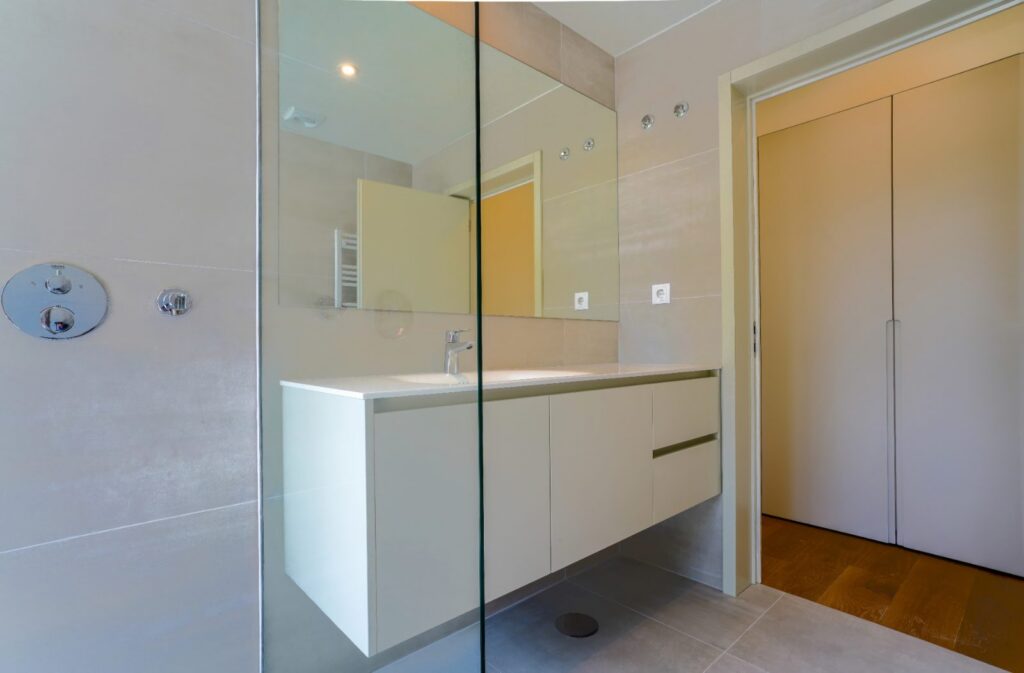
The minimum for a frameless shower screen is 6mm toughened glass. We build ours from 10mm. Understanding the gap between those two numbers is most of what you need to choose well.
Choosing between a fully framed, fully frameless or semi frameless shower screen is about more than how much aluminium you can see. The choice sets the glass thickness, decides how the panel is held to the wall, and determines how much cleaning you have signed yourself up for.
Every made to measure shower screen we fit runs through the same decisions, so here is how we work through them with you.
The short version
- Cape Byron Glass builds fully frameless screens from 10mm toughened glass, and semi-frameless and fully framed from 6mm.
- Removing the frame makes the glass structural, which is why the thickness has to go up.
- The building code and the industry association both put the minimum for a frameless panel at 6mm toughened. Cape Byron Glass builds above that minimum.
- On price, fully framed is the entry point, semi-frameless is roughly 30% more, and fully frameless roughly 50% more again.
- Want yours measured? Free measure and quote. Call Cape Byron Glass on (02) 6685 8588.
Jump to:
- Framed, semi-frameless and frameless side by side
- How thick the glass should be
- Whether frameless is worth the extra
- Hardware and finishes
- Decorative glass options
- Why we will not fit a prefab screen
What is the difference between frameless, semi-frameless and framed shower screens?
Framed, semi-frameless and fully frameless shower screens differ in how much aluminium holds the glass: framed screens are framed on every edge, semi-frameless on the outer perimeter only, and fully frameless has none at all. All three use toughened safety glass and all three, fitted properly, will keep the water in. What changes is how much of the structural work the glass has to do itself. The table shows how Cape Byron Glass builds each one.
| Fully framed | Semi-frameless | Fully frameless | |
|---|---|---|---|
| Glass thickness | 6mm toughened | 6mm toughened | 10mm toughened |
| Where the framing sits | Every edge of every panel | Outer perimeter only, door and vertical joins left clean | Nowhere. Glass to glass, glass to wall |
| What carries the load | The frame | The frame, with the glass sharing it | Brackets bolted through to the wall, plus the hinges |
| Cleaning | Most tracks and channels | Fewer channels | Least to clean, mostly just glass |
| Relative cost | Entry point | Around 30% more | Around 50% more again |
| Best suited to | Tight budgets, replacing like for like, walls well out of square | Most renovations, including holiday lets | Open bathrooms and large single panels |
Why the framing decides the thickness
Take the frame away and the glass has to become its own structure, which is why the thickness goes up. A framed panel is held on all four edges by aluminium that resists flex, carries the weight of the door and absorbs the daily shove of somebody leaning on it getting out of the shower. Remove that and the only things resisting all of it are the thickness of the glass and the brackets holding it to the wall.
How thick should shower screen glass be?
Cape Byron Glass builds fully frameless screens from 10mm toughened glass, and semi-frameless and fully framed screens from 6mm. The Australian Glass and Window Association (AGWA), the peak industry body for glazing here, puts the minimum recommended thickness for a frameless screen at 6mm where it is supported along two edges that meet in a corner, which makes 10mm a choice rather than a requirement.
That distinction matters when you compare quotes. Two frameless screens can differ in shower screen thickness, so it is worth asking which one you are being quoted.
What AS1288 covers, and what it does not
AS1288 sets the grade of glass in a shower enclosure, but AGWA notes it is not clear on how thick a frameless panel needs to be to limit flex.
- The grade of glass. Glass in a shower enclosure has to be Grade A safety glass under AS1288, the Australian Standard for glass in buildings, and AGWA’s own shower screen installation fact sheet applies the same Grade A rule to windows that form part of the enclosure. Every Cape Byron Glass screen is toughened, at every thickness.
- The thickness of the glass. The National Construction Code sets the floor: any shower panel or door with an exposed edge has to be toughened safety glass at least 6mm thick, which matches AGWA’s recommendation. A 6mm frameless screen, correctly fixed, is a compliant shower screen.
Why we build frameless screens from 10mm
We build every fully frameless shower screen from 10mm because a frameless panel has nothing holding its edges, and the extra thickness is what keeps it rigid.
AGWA’s unframed shower screen guidance notes that a frameless panel flexes more as it gets wider, and over the years that movement works against the hinges, the fixings and the silicone.
Cape Byron Glass also fixes its wall brackets mechanically, which lets a 10mm panel go wider and taller as one clean sheet. In a bathroom where somebody wants the largest possible run of clear glass inside a fixed footprint, that is usually the deciding factor.
What thicker glass will not do for you
Thicker glass makes a panel stiffer, but there are problems it cannot fix.
- It will not stop a leak. Water escapes because a screen was measured or fitted badly, or because the seals have done their years, and no amount of glass thickness compensates for either.
- It will not keep the glass clear. Water spots and soap scum land on 6mm and 10mm identically. What prevents them is a squeegee and a routine, and in a Northern Rivers bathroom that never quite dries out through February, that routine matters more than the spec does. Nanokote, a protective coating we can apply as part of the job, helps too.
Is a fully frameless screen worth the extra money?
Fully frameless costs roughly 50% more than semi-frameless, and what that buys is a stiffer panel that can go bigger, less to clean, and an uninterrupted sightline. Whether those are worth it comes down to your bathroom, so here is what each one gets you.
What the extra buys
- A stiffer panel that can go bigger. 10mm glass flexes less and can span a wider opening.
- Fewer places for grime to live. No perimeter track, no bottom channel filling up.
- An uninterrupted sightline. In a small bathroom especially, taking the frame out of the middle of the room makes the space read as bigger than it measures, and it lets the Northern Rivers light through a bathroom instead of chopping it into panels.
When semi-frameless is the smarter call
Semi-frameless is the better choice in a standard alcove or corner where you are not chasing an enormous single panel. It keeps the clean look through the door and the vertical joins, which is most of the visual benefit, and you spend the difference on tiling or tapware where it will show more.
The extra framing adds durability, which suits a holiday let. Byron, Suffolk Park and Lennox are full of properties that turn over every few days, and their bathrooms get used hard.
When fully framed still makes sense
Fully framed is the right answer when the budget is the constraint, when you are replacing an existing framed screen like for like, or when the walls are so far out of square that having the frame absorb it is the better outcome.
Nothing about a well made framed screen is second rate. Compliant, watertight, safe. It will date first, and if that does not bother you then it is the right answer and you should keep your money.
Not sure which way to go? Send us photos and rough measurements. It speeds the whole thing up, and we can tell you which of the three are realistic for your opening before anyone drives out.
What hardware and finishes can you get?
Cape Byron Glass uses Pivotech hardware exclusively, in eight finishes, and recommends brushed nickel or bright silver for coastal bathrooms because they hold up best in salt air. Sticking to one range keeps the hardware consistent across every screen we fit, so a hinge or a clip on one job matches the next.
Pivotech and Evolution are the same thing
Pivotech is the brand and Evolution is one of its suites, the semi-frameless one, so a quote listing Evolution hardware is listing Pivotech. The relationship is the same as a Ford and a Falcon, where one is the badge on the front and the other is the model. It is worth knowing when you are comparing two quotes that appear to name different products.
Brushed nickel and bright silver hold up best in salt air
Of the eight Pivotech finishes, brushed nickel and bright silver hold up best in salt air, and only brushed nickel is also one of the current favourites.
| Finish | Currently popular | Holds up best in salt air |
|---|---|---|
| Brushed nickel | Yes | Yes |
| Brushed copper | Yes | No |
| Matte gold | Yes | No |
| Bright silver | No | Yes |
The other four, brushed brass, black, white and gunmetal, sit outside both lists.
The hardware range is the same wherever we work. What we recommend is a finish that suits the coast, because salt air tarnishes hardware, and a tarnished pivot block still works perfectly well. It just never looks right again.
Both showrooms have all eight on display, which is worth doing in person, because finishes photograph very differently to how they look under bathroom lighting against the tiles you have chosen.
What decorative glass can you have?
Decorative options run to reeded and fluted glass, translucent laminate, acid etching, and ten or twelve standard obscure patterns.
Reeded and fluted glass is the strongest current trend
Reeded and fluted glass is what most people are asking for at the moment, and narrow reed in particular gets requested by name. You get privacy and texture without the flat, dated look of old frosted glass, and it catches light in a way clear glass cannot.
Privacy is not a small thing around here either. Plenty of bathrooms in this region open onto a deck, a garden or a neighbour a few metres away, and reeded glass solves that without blacking the room out. It used to be an architect’s specification on high end builds. These days it turns up in ordinary family renovations, and it looks just as good in them.
Laminate, acid etching and the standard patterns
Translucent laminate gives an even, soft diffusion right across the panel. Acid etching gives a fine, frosted finish. Beyond those sit ten or twelve standard obscure patterns that have been in the catalogues for decades and are still there because they work.
Radius corners are also popular. It is an edge detail rather than a glass type: the corners of the panel are rounded off.
Is low-iron glass worth paying for?
Standing in a finished bathroom looking at an installed screen, the difference is hard to pick. Low-iron, sometimes sold as ultra-clear, removes the faint green cast in the edge of ordinary float glass, and it costs more.
We have looked at plenty of them alongside what the customer paid extra, and the effect is much smaller in place than it is in a sample held up to the light. People ask for it because they have heard it is good and because they do not like the green.
If the green edge bothers you, and on a thick frameless panel the exposed edge is where you would notice it, then have it. If it is on your list because it appeared on somebody else’s list of upgrades, that money is better spent elsewhere in the bathroom.
Why we will not fit a screen you bought somewhere else
If you buy a prefabricated shower screen online or off the shelf and ask us to install it, we will decline. Prefab kits are built to standard sizes and bathrooms are not standard.
When the kit does not fit the opening, it cannot be installed to compliance, and we would not be comfortable putting our name on that.
Every screen we fit is measured on site and made to that measurement. That is why we do not keep a warehouse of boxed screens waiting for a bathroom to match them.
Frequently asked questions
Can you get a shower screen to fit a bathroom that is not square?
Yes. Cape Byron Glass templates and laser measures the opening on site, and the glass is made to those measurements, so a wall or floor that runs slightly out of square is built into the screen rather than left as a gap. Where the walls are well out of square, a fully framed screen can be the better choice, because the frame takes up the difference.
How much does a shower screen cost?
Cape Byron Glass prices every screen at a free measure, and five things move the number most:
- How many panels the job needs.
- Whether there is a return, or just a single front.
- Whether the door is hinged or sliding.
- Which hardware finish you choose.
- Whether you want decorative glass.
A single fixed panel over a bath and a three-sided frameless enclosure with a return are entirely different jobs.
Is a semi-frameless screen the same as a semi-framed screen?
Yes, semi-frameless and semi-framed are two names for the same product. You will see both names used, and a semi framed shower screen in one brochure is the same thing as a semi-frameless screen in the next.
Can you replace just the glass and keep the existing frame?
Sometimes, depending on whether the frame and hardware are sound and still available. Toughened glass cannot be cut once it has been toughened, so a replacement panel has to be made to the exact size, measured rather than assumed. That all gets checked at the free measure.
What happens if a shower screen breaks?
Toughened glass is heat treated so that when it fails it breaks into small blunt granules rather than long shards, which makes it far safer underfoot. The panel goes all at once rather than cracking, which is startling, but the outcome is by design. Keep everyone away from it in bare feet and give our emergency glass repairs team a call.
Let’s Get Your Bathroom Measured Properly
If you are working through a renovation, or looking at a screen that has had its day, get the opening measured before you decide anything. A free measure and quote tells you what will fit, what the three build types cost against each other in your bathroom, and which finish suits a coastal bathroom. If the job also needs a mirror or a splashback, one trade can do the lot in the one job.
Two showrooms you can walk into, at 13E Acacia St, Byron Bay and 1/2-8 Blundell Blvd, Tweed Heads South. Cape Byron Glass has been glazing homes across the Northern Rivers since 1994, with over 120 years of combined experience across the team and a 5.0-star rating on Google. Give us a ring on (02) 6685 8588, or send through photos and rough measurements to get things moving.
We look after Byron Bay, Ballina, Tweed Heads, Murwillumbah, Coolangatta and Currumbin. If you are just outside these spots, give us a ring. Chances are we can still help.
Written by the team at Cape Byron Glass.
Disclaimer: This article is general information, current at the time of writing. Every bathroom is different, so have yours measured before you order a screen.
