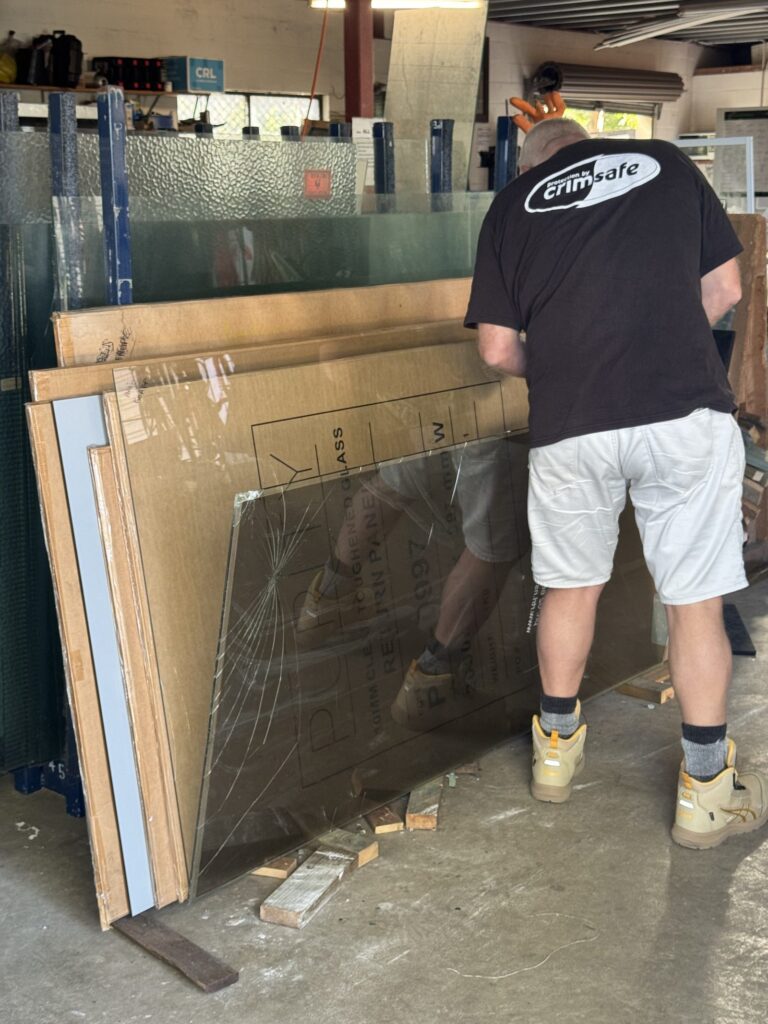
Toughened glass can’t be cut once it’s made. Laminated glass can. That one difference usually decides whether a broken pane is fixed this afternoon or boarded up while a new one is made.
The difference between toughened glass vs laminated glass comes down to how each one breaks. Toughened glass is heat treated so that it shatters into small, blunt pieces. Laminated glass has a plastic interlayer that holds the broken pieces together in the frame. Both are safety glass under AS1288, the Australian Standard for glass in buildings.
The other difference shows up on repair day. Cape Byron Glass emergency glass repair crews carry laminated glass, so a broken laminated pane is often replaced on the first visit, while toughened has to be made to size. Here’s what separates the two, how to tell which one you’ve got, and what happens when yours breaks.
The short version
- Toughened glass shatters into small, blunt granules. Laminated glass cracks, but its interlayer holds the pieces in place.
- Both count as safety glass, and both can meet the Grade A rating AS1288 calls for in doors, low windows and bathrooms.
- Some window frames only take toughened glass, so in those the replacement has to be toughened too.
- Broken glass, any hour, across the Northern Rivers and southern Gold Coast: call Cape Byron Glass on (02) 6685 8588 or 0400 245 504.
Jump to:
- How the two compare
- Which one is safer
- Why your repair might need a second visit
- Whether you can choose a different glass
- Working out which glass you’ve got
What is the difference between toughened and laminated glass?
Toughened glass is a single sheet that’s been heat treated for strength, while laminated glass is two or more sheets bonded to a plastic interlayer. They’re made differently, they break differently, and they behave very differently when a glazier needs to replace one in a hurry.
| Toughened glass | Laminated glass | |
|---|---|---|
| How it’s made | A single sheet, cut to size, heated to around 600°C and cooled fast with air | Two or more sheets bonded to a clear plastic interlayer |
| How it breaks | All at once, into small, blunt, cube-like granules | Cracks into a web, but the pieces stay stuck to the interlayer |
| Can it be cut after it’s made? | No. Cutting and edgework happen before it’s toughened | Yes. Standard laminated is cut to size from a stock sheet |
| Where you’ll often find it | Shower screens, frameless glass doors, glass pool fencing | Windows and doors, and glass that needs to stay in its frame once broken |
| For a repair at Cape Byron Glass | Ordered in and made to the exact size | Carried in stock on the vehicles |
| Safety glass? | Yes, Grade A | Yes, Grade A |
Toughened glass in one paragraph
Toughened glass starts life as an ordinary sheet that’s cut and finished to its final size, then heated to around 600°C and cooled fast with blasts of air. The NSW Government’s guidance on toughened glass explains that this makes it much stronger than conventional glass and far more resistant to impact and sudden temperature change. When it does break, the whole panel goes at once into small granules rather than jagged shards. That’s why you’ll find it in shower screens and frameless doors, where somebody might walk straight into the glass.
Laminated glass in one paragraph
If you’ve ever wondered what is laminated glass, picture a sandwich: two or more sheets of glass bonded to a clear plastic interlayer, usually PVB. When it breaks, the glass cracks into a spider web but the pieces stay stuck to the interlayer, so the pane stays in its frame instead of falling out. Standard laminated glass can also be cut to size from a larger sheet after it’s made.
Why tempered and toughened are the same thing
Tempered glass and toughened glass are two names for the same product. Tempered is the usual word in the United States and toughened is the usual word here, so you’ll see both online. Where people do get confused is laminated glass, which is also safety glass but a different product.
Which one is safer?
Neither is safer across the board. Both are safety glass, and each is designed to fail safely in its own way: toughened by breaking into small blunt pieces, laminated by holding its pieces in place.
When you want the pieces to fall away, and when you want them held in place
Toughened glass suits the places where someone might walk into the glass and a clean break is the safer outcome, such as a shower screen or a frameless door. A pile of small granules makes a mess, but it doesn’t cause the deep cuts a long shard can.
Laminated glass suits the places where you want the glass to stay in the opening after it breaks, such as a window above a drop or glass overhead. A cracked laminated window also keeps the rain out while you wait for the replacement.
What AS1288 requires
AS1288 and the National Construction Code call for Grade A safety glass in the spots people are most likely to walk into glass, and both toughened and laminated glass can meet that grade. Under the Code’s glazing and human impact provisions for houses, that includes:
- glass in doors
- glass panels right beside a doorway
- low-level glazing, where the bottom of the glass sits close to the floor
- bathrooms and ensuites, including shower screens, shower doors and bath enclosures
The exact distances and exceptions depend on the size and position of each pane, which is why we confirm them on site.
What this article doesn’t cover
Everything here is about how glass breaks in ordinary knocks, falls and accidents, not how either type holds up against someone trying to force their way in. If security is on your mind, that’s a conversation about Crimsafe and security screens, and we’re happy to have it.
Why can some broken glass be replaced today and some cannot?
The glass type usually decides it. Laminated glass is carried in stock, while toughened glass can’t be cut once it’s made, so a toughened replacement has to be ordered in.
Roughly six jobs in ten are glazed on the spot
Around 60% of Cape Byron Glass emergency jobs are glazed on the first visit, and the rest are made safe and finished on a return trip. Our guide to what happens after you call a glazier walks through that process.
Laminated is carried in stock
The crew vehicles are fitted out as mobile workshops with laminated glass on board, so when a laminated pane breaks, the replacement can usually be fitted on the same visit.
Toughened can’t be cut once it’s been toughened
Every cut, hole and polished edge has to be done before glass goes into the toughening furnace. Try to cut it afterwards and the whole sheet shatters, exactly the way it does when it’s struck. So a toughened replacement has to be measured precisely, ordered, made to that exact size and fitted on a second visit.
What a board-up is doing in the meantime
While the toughened pane is being made, the opening is made safe and boarded up, so the house can be locked and the weather stays out.
If yours is only cracked
A pane that’s cracked but still sitting firmly in its frame is a different decision from one that’s shattered, and it doesn’t always need a board-up while the new glass is made. Our guide to cracked glass covers how to tell whether yours can wait.
Most of these jobs are more routine than they feel
Replacing a single broken pane is everyday work for the Cape Byron Glass glazing team, whether it’s a laminated window finished in an afternoon or a toughened door panel that takes two visits. It feels like a crisis when it happens. For us it’s a familiar job with a clear set of steps.
Got broken glass right now? Ring (02) 6685 8588 or 0400 245 504 and send through a photo with rough measurements. We’ll tell you which glass it looks like and whether it’s likely to be finished on the first visit.
Can you put a different type of glass in when you replace it?
Sometimes. It depends on the frame and on where the pane sits.
The like-for-like rule, and why it’s not us being difficult
A replacement pane has to suit the frame it’s going into and the spot it sits in. When a glazier says the new glass has to match the old, it’s because the frame was built for that glass.
Some frames will only take toughened glass
Paul Hilleard, owner of Cape Byron Glass, says certain window frames and extrusions will only take toughened glass. A frame built around toughened glass won’t accept a laminated pane, even when laminated is the glass sitting on the vehicle. In those cases the only path is a toughened replacement made to size.
When an upgrade is an option, and when it isn’t your call
Where a frame will take more than one type, you do get a choice. A window on a noisy street might suit acoustic laminate, and a room that cooks in the afternoon sun might suit Low-E or a tint. Those are worth talking through on a planned replacement, rather than at 10pm with a board over the hole.
You can’t change where the pane sits, though. If the broken pane sits in a door, beside a doorway, low to the floor or in a bathroom, the replacement generally has to be Grade A safety glass under AS1288, whatever was there before.
How can you tell whether your glass is toughened or laminated?
The quickest way to tell if glass is toughened or laminated is to look for the safety glass mark in a corner of the pane. If you can’t find one, the edge of the glass and the way it broke are the next best clues.
The mark in the corner
Under the National Construction Code, safety glass has to be marked, either with a permanent etching or with a label that can’t be reused once it’s peeled off. Check the corners of the pane for a small etched stamp. Many marks name the glass type outright, such as toughened or laminated, and the grade. Safety glass in a new installation has to carry a permanent mark like this. An older pane with no mark may not be safety glass at all.
The edge
If an edge of the glass is exposed, look at it side on. Laminated glass shows two thin lines of glass with a fine layer between them. Toughened and ordinary glass both look like one solid sheet, so the edge only rules laminated in or out. Most window frames hide the edge, so this check works best on frameless panels and doors.
How it broke
Once a pane has broken, the answer is usually obvious. Toughened glass breaks all at once into small granules, which either fall out or sit crazed in the frame. Laminated glass cracks into a web and stays in the frame. Ordinary float glass, found in plenty of older windows, breaks into long, sharp shards.
When to just send a photo
If you still can’t tell, don’t go poking at a broken pane to find out. A photo of the damage, plus one of any mark in the corner, is usually enough for a glazier to tell you which glass it is and what happens next.
What other glass types are worth knowing about?
Beyond toughened and laminated, the glass types that come up most around a house are acoustic laminate, Low-E, double glazing, fire and bushfire-rated glass, and decorative glass such as tinted, frosted, obscure and fluted.
Acoustic laminated glass
Acoustic laminated glass swaps the standard interlayer for one designed to dampen sound. It earns its keep in a bedroom or home office near the highway, and it’s still a laminated safety glass, so the pieces stay held in place if it breaks.
Low-E and double glazed
Low-E glass carries a near-invisible coating that cuts the heat moving through the pane. Double glazing seals two panes with a gap between them, which helps with both temperature and noise.
Fire-rated and BAL-rated glass
Fire-rated glass is made to hold back fire for a set period, and BAL-rated glass is specified to suit a property’s bushfire attack level. That comes up most in the hinterland around Murwillumbah and the Tweed Valley, where Cape Byron Glass specifies BAL-rated glazing whenever the site calls for it.
Tinted, frosted, obscure and fluted
Tinted glass cuts glare and heat, while frosted, obscure and fluted glass give privacy and still let the light through. You’ll see them in bathrooms, beside front doors and in street-facing windows. Fluted and reeded glass has also become a popular pick for shower screens.
Toughened safety glass in shower screens
Every Cape Byron Glass shower screen is toughened safety glass to AS1288. Our guide to frameless, semi-frameless and framed screens explains the thickness of each.
Frequently asked questions
Which is better for a sliding door, toughened or laminated?
Neither is better outright. Both are Grade A safety glass and both are used in sliding doors. What separates them is how they break: toughened breaks into small granules, while laminated cracks and stays put until it’s replaced. On a repair, the existing frame sometimes settles it.
What does 6.38 mean on laminated glass?
It’s the nominal thickness in millimetres. 6.38 laminated glass is roughly 6mm of glass, usually two 3mm sheets, with a standard 0.38mm plastic interlayer bonded between them. It’s a common thickness in house windows. Heavier laminates such as 10.38 and 12.38 follow the same pattern, with thicker glass and the same interlayer, which is how most laminated glass thickness figures in Australia are written.
How long does a toughened replacement take to arrive?
There’s no single answer, because it depends on the size of the pane and the edgework it needs. Cape Byron Glass gives you a timeframe when the pane is measured, and the opening is boarded and secured in the meantime, so you’re not left with a hole in the house.
Does a shower screen have to be toughened glass in Australia?
For any screen with an exposed glass edge, yes. Under the National Construction Code’s bathroom glazing rules, framed shower panels need Grade A safety glass, and any panel or door with an edge exposed has to be toughened safety glass at least 6mm thick. That covers frameless and semi-frameless screens, where the door and joins are bare glass.
What does AS1288 cover?
AS1288, Glass in buildings: Selection and installation, sets out how glass is chosen and installed so it’s strong enough for the job and safe where people might come into contact with it. Standards Australia lists glass strength, installation for different building applications, and special uses such as overhead glazing and barriers among what it covers, and the Standard is aligned with the National Construction Code. It doesn’t cover everything made of glass: furniture glass and lift cars sit outside it.
Not Sure What Glass You’ve Got? Send Us A Photo
Whichever glass broke, the first steps are the same: keep everyone clear of it, take a photo, and ring Cape Byron Glass on (02) 6685 8588 or 0400 245 504. Send the photo through, add rough measurements, and we’ll know what glass to bring. If it’s toughened, we’ll make the opening safe the same day and come back with the new pane.
The emergency glass repairs line runs 24 hours a day, every day of the year. For a planned upgrade such as acoustic laminate or Low-E, we’ll book you in during business hours.
We look after Byron Bay, Ballina, Tweed Heads, Murwillumbah, Coolangatta and Currumbin, with showrooms at 13E Acacia St, Byron Bay and 1/2-8 Blundell Blvd, Tweed Heads South. If you’re just outside these spots, give us a ring anyway. Chances are we can still help.
Written by the team at Cape Byron Glass.
Disclaimer: This article is general information only. Safety glass requirements depend on where each pane sits, so have your glass assessed on site before choosing a replacement.