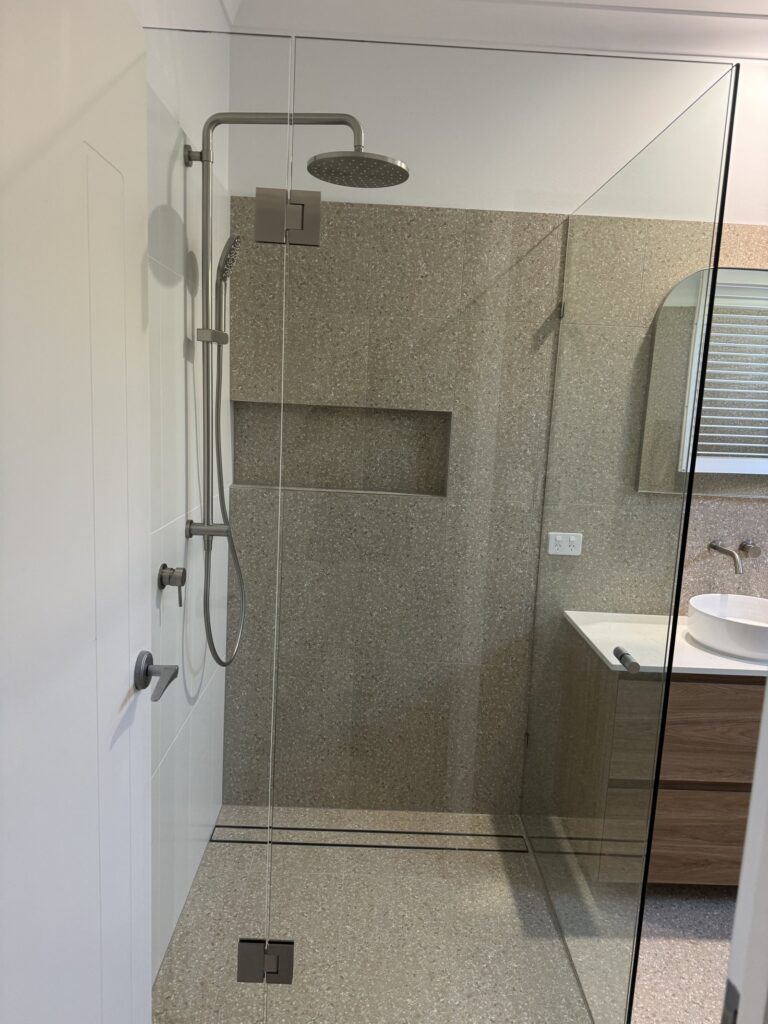
Every shower screen seal wears out eventually. Most give you a few good years, bleach takes a chunk out of that, and the first sign is usually a puddle on the bathroom floor.
A leaking shower screen usually comes down to one of two things: a shower screen seal that has worn out, or a screen that was never fitted properly in the first place. One is an inexpensive part you can swap yourself. The other needs the screen looked at, and sometimes replaced.
A dry bathroom floor is one of those things you only notice once it’s gone. This article covers what fails on a shower screen, in what order, and what you can do about each part, from the seals and hardware through to the glass itself.
The short version
- Most leaks come from a worn seal or a screen that doesn’t fit its opening properly.
- Seals last around four to five years and you can replace them yourself. Bleach and harsh cleaners wear them out faster.
- Salt air tarnishes hardware, usually from around the 10 year mark, and ages seals sooner. The glass lasts indefinitely unless it breaks or is left to stain.
- A daily squeegee is the best habit for clear glass.
- Leak, tarnish or a tired screen? Give Cape Byron Glass a ring on (02) 6685 8588.
Jump to:
- Working out why your screen leaks
- Replacing the seals yourself
- Cleaning products to keep away from the screen
- Whether a glass coating is worth it
- How long each part should last
Why is my shower screen leaking?
A shower screen leaks when water finds a gap the screen was meant to close, usually under the door, down the hinge side or where the glass meets the wall. Whether that gap comes from the fit or from a worn seal decides the fix, so it pays to work out which one you’ve got.
The number one cause: a screen that doesn’t fit
The complaint Cape Byron Glass hears most is a shower screen leaking because it was never fitted properly. If a panel sits a few millimetres off the wall, or the door doesn’t close square to its opening, water gets out however new the seals are. It usually traces back to a screen that went in incorrectly, or a boxed kit that was never made for that bathroom.
The second cause: a seal that has done its years
The other common cause is a seal that has worn out. Seals, the rubber and plastic strips along the bottom and edges of a door, close the last few millimetres between the glass and the tiles. The Australian Glass and Window Association lists seals and deflectors as standard on semi-frameless and frameless screens. Once a seal hardens, splits or falls off, water walks straight past it.
How to tell the difference before you spend money
Start with when the leak began. A screen that has leaked since the day it was installed points to the fit. A screen that kept the water in for years and has only started leaking points to the seals. Then take a close look:
- Seals that are hard, cracked, curling or missing: a seal problem.
- A gap between the glass and the wall that’s wider at one end than the other: a fit problem.
- A door you have to lift or push to close: the hinges or the fit, not the seals.
- Silicone at the wall that’s lifting, blackened or missing: a resealing job.
Leaking at the bottom of the door
A shower screen leaking at the bottom of the door usually means the bottom seal has failed. That’s the strip along the lower edge of the door that sweeps against the hob or floor, and it gets kicked, mopped and scrubbed more than any other part of the screen, so it’s usually the first to go. If the bottom seal looks fine, check whether the door has dropped. A door that has dropped on its hinges no longer lines up with its opening, so even a brand new seal can’t close the gap.
What fixes a screen that never fitted
New seals won’t save a screen that doesn’t match its opening. What keeps water in is a screen measured to the actual opening, fixed with industry-grade fittings and sealed with the right silicone. Cape Byron Glass measures every screen on site against the finished tiles, and our guide to shower screen installation explains how that measuring works and why it stops leaks.
Not sure which one you’re looking at? Give us a ring on (02) 6685 8588 or send us a photo, and we’ll tell you whether it’s a seal you can swap yourself or a screen that needs a proper look.
How long do shower screen seals last, and can you replace them yourself?
Shower screen seals last around four to five years, and yes, you can replace them yourself. Cape Byron Glass can cut new seals to length.
Four to five years is a realistic expectation
A seal in daily use gets roughly four to five years before it starts to harden, split or let go. Heavy use brings that forward, whether it’s a holiday rental turning over every few days or a family bathroom with a queue every morning. Over the life of a screen, expect to replace the seals a few times, the same way you’d replace a tap washer.
Yes, you can do it yourself, and we’ll cut them to length
You don’t need a glazier to replace shower screen seals. People come in to see us all the time with an old seal in hand. We cut new ones to length, and they pull the old ones off and fit the new ones at home. Seals are available for the bottoms and the backs of doors, so you can replace the one that has failed or do the full set at once.
Hard, torn or dropped off: what each one is telling you
Each kind of failure tells you something slightly different, but all three end the same way: a new seal.
- Gone hard. The rubber has aged. It still looks whole, but it no longer flexes against the tile, so water slips underneath.
- Torn or split. The seal has worn through, most often on the bottom of the door where feet, mops and brushes hit it every day.
- Dropped off. The seal has perished or shrunk enough to lose its grip on the glass edge.
What cleaning products destroy a shower screen?
Bleach and harsh chemical cleaners do the most damage to a shower screen. Used week after week, they break down anything rubber or plastic on the screen and tarnish the hardware.
Bleach perishes anything rubber or plastic
Seals, sweeps and plastic parts are the first casualties. Bleach and strong chemical cleaners break them down over time, so seals give up years early. One heavy clean won’t do it. Consistent use, clean after clean, does.
Hardware tarnishes, even though it keeps working
Harsh products tarnish the hinges, clips and pivot blocks as well. They don’t weaken a clip or a pivot block, so the door still swings and the glass stays put. The finish is what suffers, and a hinge that has gone dull and blotchy makes a whole bathroom look older than it is.
Why holiday rentals feel it most
Holiday rentals and Airbnbs see this more than anywhere else. Commercial cleaners on a tight turnover want to get in and out quickly, so they reach for strong products that cut through grime fast. Across a year of changeovers, that’s the kind of steady exposure that wears seals out early and dulls the hardware. From Byron Bay holiday lets to Kirra, that adds up fast.
A pre-season shower screen check for rental owners
Before each busy run, whether that’s mid-December, Easter, or the winter and spring school holidays, walk through every bathroom and check these six things:
- Seals. Still soft, whole and gripping the glass?
- The door. Does it close on its own swing, without lifting or pushing?
- Hardware. Any tarnish, pitting or loose clips?
- Silicone. Intact at the wall, or lifting and blackened?
- Glass. Clear, or building up a cloudy film?
- The floor. Dry after a shower, or wet outside the screen?
Replace tired seals before the season starts rather than after a guest complains about a wet floor.
What to tell your cleaner
If someone else cleans the bathroom, this is the line to pass on: “Clean the shower screen with warm water, a mild detergent and a soft cloth. No bleach, nothing abrasive, and squeegee the glass when you’re done.” That covers how to clean a glass shower screen without hurting the seals or the hardware finish. When you’re buying supplies, skip any bleach-based shower screen cleaner. Put it in the cleaning brief and on a card in the bathroom cupboard.
How do you stop water spots and that cloudy look on shower glass?
Squeegee the glass after every shower and keep up a regular clean. Water stains on shower glass build up when water dries on the glass, and the simplest way to stop them is to not let it dry there.
The daily habit that does the most work
A squeegee clears most of the water before it can dry into a spot. Paul Hilleard, who owns Cape Byron Glass, keeps his advice simple: squeegee the glass daily and get into a cleaning routine. Hang the squeegee in the shower so it’s there when you need it.
Why consistency beats intensity
A light clean every week does more than a big scrub every few months. Once soap scum and water marks have built up for months, shifting them takes stronger products and more elbow grease, and that’s when the seals and hardware start copping damage. A screen that’s kept clean never needs the harsh stuff.
What causes the marking
Two things cloud shower glass: water spots, left behind when water dries on the glass, and soap scum from body wash and shampoo. Harsh cleaning products can make the marking worse, not better.
What untreated glass looks like after a few years
Glass that’s never squeegeed or properly cleaned develops a permanent water-stained look that scrubbing won’t fully shift. Nothing structural happens to the glass. It just stops looking clear, and in a bathroom that’s otherwise in good shape, that’s the first thing you notice.
Is an easy-clean glass coating worth it?
Yes, if you want clearer glass with less scrubbing. It doesn’t replace the squeegee, but it makes every clean easier.
What Nanokote does
Nanokote, the easy-clean coating Cape Byron Glass applies, is a clear coating that repels water and resists water spots, soap scum and limescale. Water runs off rather than sitting on the surface and drying into marks, so the glass stays clearer between cleans. Nanokote says a coated shower screen needs up to 90% less cleaning.
A 10 year performance warranty, when it’s professionally applied
Nanokote’s 10 year performance warranty applies when the coating is professionally applied. Cape Byron Glass is an approved Nanokote applicator, so a coating done as part of your job qualifies for that warranty.
The independent test results
Nanokote’s published test results
- Less than 10% change in water contact angle after 10,000 double abrasion cycles (ASTM D2486 scrub resistance test), from an independent NATA-approved laboratory.
- An initial water contact angle of 115 degrees (DIN EN 828).
- No change to the coefficient of friction.
In plain English, the coating kept repelling water after heavy, repeated scrubbing in the lab rather than wearing off after a season of cleaning. A contact angle of 115 degrees means water sits on the glass as a tight bead instead of spreading flat, which is why it runs off. And because the friction doesn’t change, coated glass is no more slippery than uncoated glass.
Ten to twelve years of using it
Cape Byron Glass has been applying Nanokote for roughly 10 to 12 years. Every so often the team goes back to a house to fit a second bathroom years after the first, and the older screen with the Nanokote coating is still looking good.
What does salt air do to a shower screen on the coast?
Salt air perishes the seals and tarnishes the hardware on a shower screen. The glass itself isn’t affected.
It shows around the 10 year mark
Hardware loses its finish from around ten years in Cape Byron Glass’s experience, and seals lose their give sooner. In coastal homes, the humid, salty air works slowly on the metal and the rubber.
Brushed nickel and bright silver hold up best
Brushed nickel and bright silver are the two hardware finishes that hold up best in salt air, and Cape Byron Glass says so even when the trend is pulling towards brushed copper or matte gold. If you’re choosing hardware for a home close to the water, start with those two. Same Pivotech range everywhere; only the finish advice changes near the water. Our guide to framed, semi-frameless and frameless shower screens covers the full range of finishes.
How long should a shower screen last?
Seals fail first, at around four to five years. Hardware finishes tarnish next, and the glass outlasts both.
| Part | Realistic lifespan |
|---|---|
| Glass | Indefinite, unless it’s broken or left to water-stain |
| Hardware | 12 to 15 years, even in a holiday rental or busy family bathroom. Near the coast the finish can tarnish from around 10 years while the hinges and clips keep working |
| Seals | 4 to 5 years, then replace and repeat |
What’s worth repairing and what’s worth replacing
Worn seals, a single hinge or pivot block, and tired silicone are all repairable.
“We needed help in a hurry fixing a shower door… sent a cheerful tradesperson (Jeff!) the next day. He sorted our issue within half an hour.”
Kate Crisp, Google review
A screen that has leaked since the day it went in, or one where the hardware is worn out and the look has dated, is usually worth replacing. Our guide to how shower screen installation works covers what a replacement involves, from the measure to the fitting.
What does the warranty cover?
Cape Byron Glass covers its shower screens for roughly 12 months, assessed job by job (the Nanokote coating carries its own 10 year warranty). Paul’s view is that if something breaks in the first year, it comes down to the product or the installation, and it gets looked at.
Roughly 12 months, assessed job by job
When something goes wrong, someone goes out, looks at it, and works out what happened.
What happens when something lets go early
If it’s within reason, Cape Byron Glass replaces the part. On one recent job, a pivot block on a screen fitted a couple of years earlier was replaced at no cost to the owner. That was outside the 12 months, and it was a call made on that job rather than a promise for every job.
Wear and tear isn’t a warranty claim
Seals wear out after a few years, salt air and bleach tarnish hardware, and water spots mark glass. That’s normal wear rather than a fault.
Frequently asked questions
Is a leaking shower always the screen’s fault?
No. If water is turning up outside the bathroom, in the room next door, inside a wall or on the ceiling below, the screen probably isn’t the culprit. That pattern usually points to the waterproofing or the grout, which is a job for a tiler or waterproofer rather than a glazier. A screen leak shows up on the bathroom floor just outside the shower. If you’re not sure which you’ve got, give us a ring on (02) 6685 8588 and we’ll tell you the easiest way to send a photo.
Can you replace shower screen seals without removing the glass?
Yes. Most seals push or slide onto the edge of the glass, so the panel and door stay where they are. Clean and dry the glass edge before fitting the new seal. Bring the old seal with you when you buy a replacement, because seals are made to suit a particular glass thickness and profile, and a 6mm semi-frameless door takes a different seal to a 10mm frameless one.
How long does a Nanokote coating last?
In Paul’s experience, a professionally applied Nanokote coating lasts about as long as its warranty. The coating doesn’t take away the need for a squeegee, though. Water still lands on the glass, and wiping it off is what keeps a coated screen looking its best.
Do hard water stains cause the marks on my shower screen?
Hard water does mark glass, but it isn’t the local problem most people assume. In Paul’s experience, the water around Byron Bay, Ballina and the Tweed isn’t too bad, and the hard water country is a fair way west of here. On this coast, hard water stains on shower glass are rarely the issue. The marks come from water spots, soap scum and harsh cleaning products. A squeegee and a regular, gentle clean deal with all three.
Sort Out That Leaking Shower Screen
A seal that’s had its day, hardware that’s lost its shine, a screen that has never kept the water in: Cape Byron Glass handles all three, from shower screen repairs to replacement screens and Nanokote coatings, across the Northern Rivers and southern Gold Coast. Give us a ring on (02) 6685 8588, or book a free measure and quote for a replacement screen.
We look after Byron Bay, Ballina, Tweed Heads, Murwillumbah, Coolangatta and Currumbin, with showrooms at 13E Acacia St, Byron Bay and 1/2-8 Blundell Blvd, Tweed Heads South. If you’re just outside these spots, give us a ring anyway. Chances are we can still help.
Written by the team at Cape Byron Glass.
Disclaimer: This article is general information only. If you’re unsure what’s causing a leak, have the screen looked at before replacing parts.